Flights to Kenya from Australia have resumed standard one-stop options after Smartraveller lowered its advice for Qatar and the UAE to Level 2 on 8 October 2026. This change allows Australian travellers to connect to Nairobi through the popular hubs of Doha and Dubai again. The update restores the most common and convenient flight paths for safari travellers departing from Australia's east coast.
This guide details the updated flight routes from major Australian cities and clarifies the current Smartraveller advice for all transit hubs. We also explain the safari logistics that airlines do not cover, such as timing your arrival for bush flights and adhering to the 15 kg soft-bag luggage rule.
Last checked: 10 October 2026 AEDT
The Best Flight Routes to Kenya from Australia

The most reliable flights to Kenya from Australia involve a single stop, as no direct flights are available. Your choice is between transiting through the Middle East with Emirates (via Dubai) or Qatar Airways (via Doha), or flying via Southern Africa with airlines like South African Airways (via Johannesburg).
Smartraveller's update on 8 October 2026 normalised Dubai and Doha as transit points, rating them at 'Level 2'. Your chosen route affects your total travel time and, more importantly, your arrival time in Nairobi, which dictates your onward safari connection.
Flights from Sydney (SYD) to Nairobi (NBO)
Sydney offers established one-stop services to Nairobi's Jomo Kenyatta International Airport (JKIA) on Qatar Airways via Doha (DOH) and Emirates via Dubai (DXB). The airborne time is approximately 20 hours. As of 8 October 2026, both the UAE (Dubai) and Qatar (Doha) are at Smartraveller's 'Level 2: Exercise a high degree of caution'. Most flights from Sydney depart late evening, arriving in Nairobi in the late afternoon. This timing requires an overnight stay in Nairobi before your morning safari flight from Wilson Airport.
Flights from Melbourne (MEL) to Nairobi (NBO)
Travellers from Melbourne also favour the one-stop routes through the Gulf hubs on Emirates (via Dubai) and Qatar Airways (via Doha). The total airborne time is around 20 hours. Both transit hubs hold a 'Level 2: Exercise a high degree of caution' rating from Smartraveller as of 8 October 2026. The late-evening departures from Melbourne result in a late-afternoon arrival at JKIA, making a same-day safari connection impossible. An overnight stay in Nairobi is necessary to rest before an early start.
Flights from Perth (PER) to Nairobi (NBO)
Perth’s location provides more diverse flight options to Kenya. Besides Emirates and Qatar Airways services, travellers can fly west via Southern Africa. South African Airways offers single-ticket itineraries to Nairobi via Johannesburg (JNB), which is also at Smartraveller Level 2. Qantas also flies directly to Johannesburg, where a separate connecting flight to Nairobi can be booked. This western route can offer shorter total travel times, but arrival schedules still require careful planning around safari flight departures from Wilson Airport.
Smartraveller Advice for Kenya Transit Hubs
The Australian Government lowered its Smartraveller advice for both the United Arab Emirates (Dubai) and Qatar (Doha) to 'Level 2: Exercise a high degree of caution' on 8 October 2026. This change followed a temporary 'Level 3' warning that complicated transit and could affect travel insurance. The move to Level 2 restores these airports as standard, reliable transit points for Australians travelling to Africa.
A Level 2 advisory is common for many global destinations and simply means travellers should be aware of potential risks. For passengers remaining within the airport for transit, the practical implications are minimal. Other transit hubs for Kenya, including South Africa (Johannesburg) and Mauritius, also currently sit at Level 2.
How Long are Flights to Kenya from Australia?
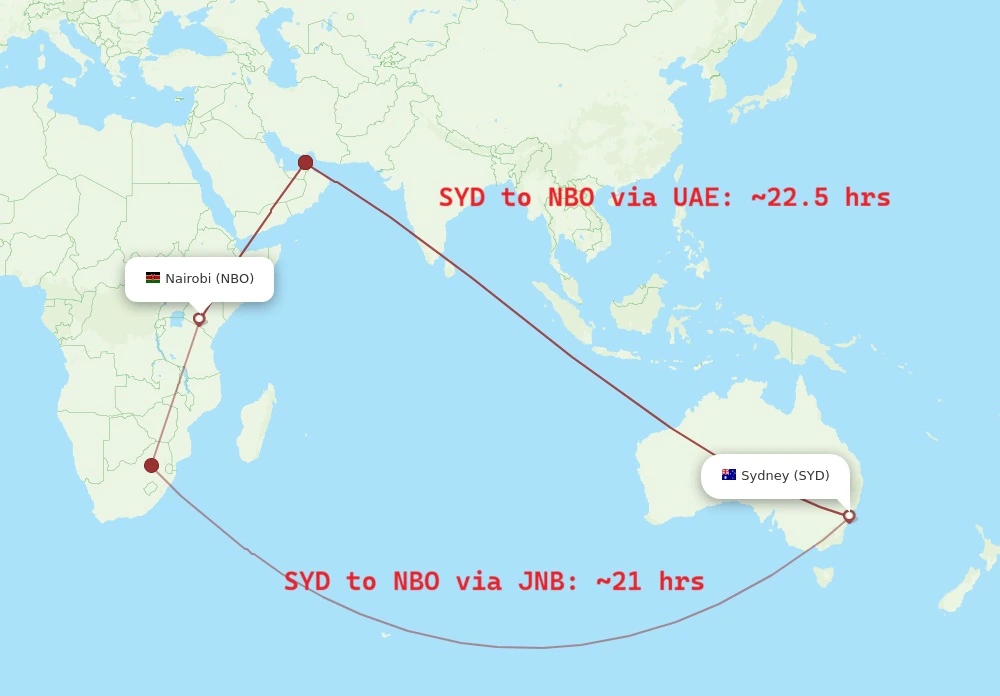
The total journey time from Australia's east coast to Nairobi is between 22 and 30 hours, including one stop. From Perth, this journey time can be less than 20 hours. Airborne time alone is approximately 20 hours from Sydney or Melbourne.
A comfortable layover is typically between two and four hours, which allows for a relaxed airport transit. We recommend avoiding itineraries with multiple stops or very short connection times to prevent exhaustion before your safari begins and to better manage Australian jet lag.
Why an Overnight Nairobi Stay Necessary for Safari Flights
Synchronising your international arrival with your internal safari flight is a key part of safari planning. International flights land at Jomo Kenyatta International Airport (JKIA), while small safari aircraft depart from Wilson Airport (WIL), a separate airport about 15 km away. The road transfer between them takes 45 to 90 minutes, depending on traffic.
Most safari flights depart in a morning block between 7:30 AM and 10:00 AM. To connect on the same day, your international flight must land at JKIA no later than 6:00 AM. This timing allows for customs, baggage claim, and the airport transfer.
Because most flights from Australia arrive in the afternoon or evening, virtually all Australian travellers must plan for an overnight stay in Nairobi on arrival. This practice ensures a stress-free start, providing a comfortable transfer to Wilson Airport the next morning. An overnight stay also offers a chance for a half-day trip to Nairobi National Park.
Luggage Rules for Kenya Safari Flights that You Need to Know Before Safari Travel
All fly-in safaris in Kenya have strict luggage rules for the light aircraft that depart from Wilson Airport. These restrictions are for aircraft safety and are non-negotiable.
- Weight Limit: A firm 15 kg (33 lbs) per person. This limit is all-inclusive, covering your main bag, daypack, and camera gear.
- Soft Bags Only: Your luggage must be a soft-sided bag without a rigid frame or wheels, like a duffel bag. Hard-shell suitcases are forbidden as they cannot be loaded into the small aircraft cargo holds.
To meet these luggage limits, wear your heaviest items, such as hiking boots and a jacket, during your flights. We can organise secure luggage storage in Nairobi for travellers on combined safari and beach holidays, as detailed in our safari-and-beach transfer guide.
Why Must Safari Luggage Be a Soft Bag?
Many first-time safari travellers focus on the 15 kg weight limit but underestimate the importance of the 'soft bag' rule. The reason is physical: cargo pods on light aircraft like the Cessna Caravan are small and have curved surfaces. A rigid suitcase will not fit through the cargo hatch or conform to the pod's shape.
Your bag must be malleable, such as a classic canvas or nylon duffel bag without wheels. The ground crew at Wilson Airport must be able to compress bags to fit them alongside luggage from other passengers. Choosing the right bag in Australia prevents having to re-pack into a new bag at the airport.
How Smartraveller Advice Affect Travel Insurance
The Australian Government's Smartraveller advice level for a destination can affect your travel insurance validity. With the UAE and Qatar now at 'Level 2: Exercise a high degree of caution', these transit hubs are generally covered by most Australian insurance providers.
It is your responsibility to confirm this coverage. Before buying a policy, you must read the Product Disclosure Statement (PDS) to check for exclusions related to government travel warnings. Securing a policy that covers all transit points is a mandatory condition for travelling with us.
How Australians Find Cheaper Flights to Kenya
The most effective strategy to reduce flight costs is to book 9 to 11 months before your travel dates. You can also make large savings by being flexible with your dates. Flying during the shoulder seasons (April-May and November) is less expensive than the peak safari period of July to October.
Comparing different routes can also yield better prices, particularly checking fares via Johannesburg from Perth. When you create your budget, remember to include the Australian Government's Passenger Movement Charge (PMC), currently A$70 per person, which is included in your ticket price.
Visas and Vaccinations that Australians Need for Kenya
Australian passport holders need an electronic travel authorisation (eTA) to enter Kenya. You must get the eTA online before you travel and should allow at least one week for processing.
A Yellow Fever vaccination certificate is mandatory for entry to Kenya if you are arriving from, or have transited for over 12 hours through, a country with a risk of Yellow Fever transmission. Consult a travel doctor 6-8 weeks before your departure to discuss other recommended vaccinations and to get a prescription for anti-malarial medication.
| Safari Logistic | Requirement for Australian Travellers |
|---|---|
| International Airport | Nairobi Jomo Kenyatta (JKIA) |
| Internal Safari Airport | Nairobi Wilson (WIL) |
| Luggage Weight Limit | 15 kg total per person (including carry-on) |
| Required Bag Type | Soft-sided bag (duffel style, no frame or wheels) |
| Arrival Night Plan | Overnight hotel in Nairobi is standard |
How to Coordinate Booking Flights and Your Safari Itinerary
We recommend booking your travel in a specific order to ensure all parts of your trip align. Finalise your ground safari itinerary first, then book international flights to match those dates. This process confirms your internal bush flight schedule before you commit to international airfares.
Working with a safari specialist is key to managing the on-ground details, such as airport transfers and luggage compliance, which fall outside an airline's services. This approach also allows you to plan helpful stopovers, like a 24-hour break in Dubai, to help manage jet lag before your safari begins.
Send us your city and dates and we'll build the safari around your flights. Start planning with a Kenya specialist today.