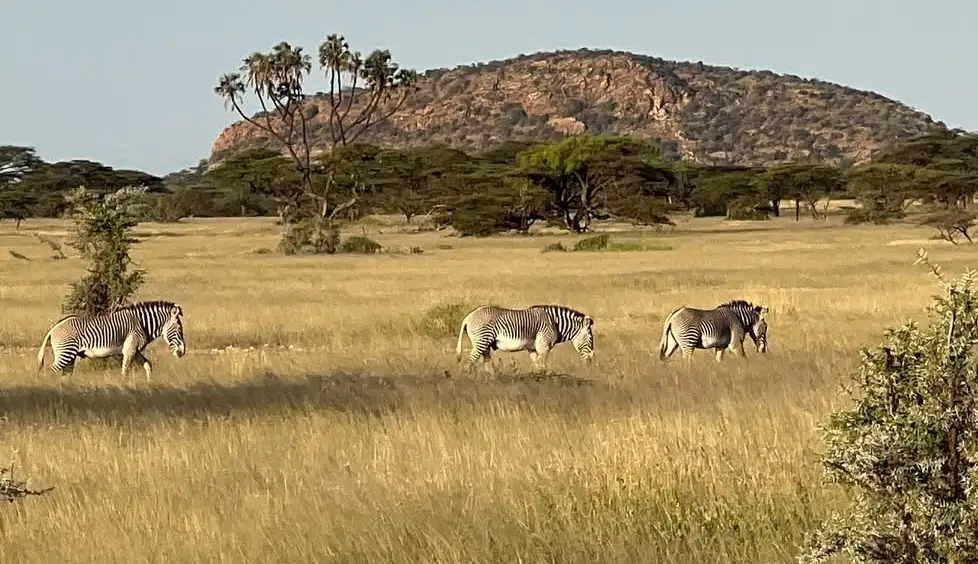
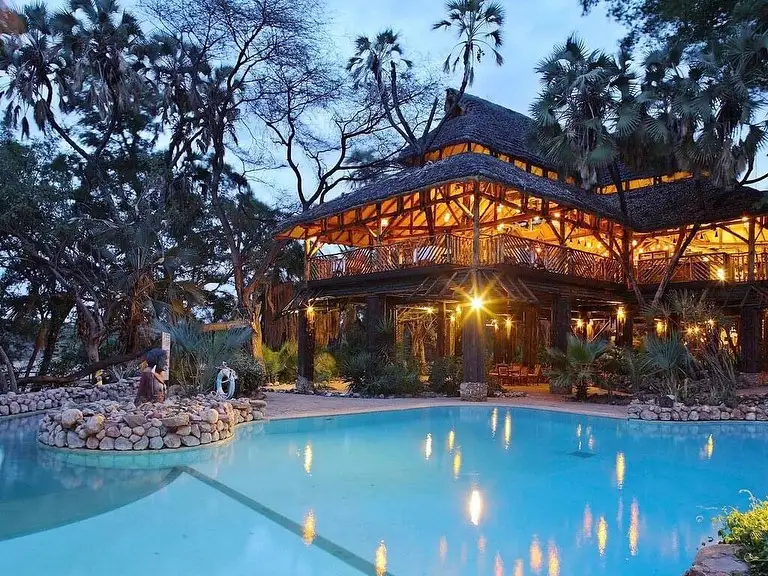
A semi-arid biome defines Northern Kenya, setting it apart from the country's southern savannahs. Shaba National Reserve in Isiolo County forms a core component of this northern conservation area alongside Samburu and Buffalo Springs Reserves. Its character is defined by dramatic volcanic geology and highly specialised wildlife adapted to the arid conditions.
Overview
Name
Shaba National Reserve
Type
National Park
Town
Isiolo
County
Isiolo
Country
Kenya
The Volcanic Terrain and Lifeline Rivers of Shaba National Reserve
Past volcanic activity shapes the rugged and arid terrain of Shaba National Reserve. The reserve covers 239 square kilometres and sits at a lower altitude than many of Kenya's other parks, contributing to its hot, dry climate. Its terrain presents stark contrasts, from rocky ancient lava flows to the dense riverine forests that follow its primary water sources.
The Volcanic Cone of Mount Shaba
The volcanic cone of Mount Shaba dominates the geography, rising to an elevation of 1,525 metres. Extensive ancient lava fields and rugged rock formations cover much of the reserve, creating dramatic scenery for wildlife viewing. These rocky outcrops and kopjes provide ideal habitat and vantage points for predators, particularly leopards.
The Ewaso Ng'iro River and Permanent Springs
The Ewaso Ng'iro River marks the reserve's northern boundary and is the main artery of water for the region's fauna. Within the reserve, the perennial Shaba Springs are a critical lifeblood. These natural springs create green oases of doum palm forest and swampland that attract high concentrations of animals, especially during the dry seasons.
The Mineral-Rich Magado Crater
On the southern boundary of the reserve is the Magado Crater. This extinct volcanic crater contains a significant deposit of sodium bicarbonate, which the local Borana community mines for their own use and for their livestock. The crater's saline, alkaline marshes create a valuable mineral lick for wildlife and attract specific bird species.
Wildlife of Shaba National Reserve and the Samburu Special Five
Wildlife in Shaba has adapted to harsh, dry conditions. The reserve is typically less crowded than its neighbour, Samburu, offering a more solitary game viewing experience. The focus for many visitors is on the northern Kenya species that do not occur in parks like the Maasai Mara.
The Samburu Special Five
Shaba is a prime location for observing the five northern specialist species, collectively known as the Samburu Special Five. These animals possess unique adaptations for survival in their arid environment.
Reticulated Giraffe: Recognised by its striking, net-like pattern of clean white lines over deep orange-brown patches.
Grevy's Zebra: A large zebra species with fine, narrow stripes that do not extend to the belly or lower legs.
Beisa Oryx: A powerful antelope with long, rapier-like horns and distinctive black-and-white facial markings.
Somali Ostrich: The males are identified by their blue-grey necks and legs, which differ from the pink of the common ostrich.
Gerenuk: A long-necked antelope famous for standing erect on its hind legs to browse on acacia and other bushes.
Predators of the Reserve
Leopards are frequently sighted in Shaba, using the rocky terrain for camouflage and ambush. Lions and cheetahs are also resident, though they can be more elusive than in other reserves. Spotted and striped hyenas are present, and the Ewaso Ng'iro River supports a large population of Nile crocodiles.
Birdwatching in Shaba and the Endemic Williams's Lark
The reserve is a rewarding destination for ornithologists, with over 450 bird species recorded. Of particular importance is the Williams's Lark, a rare, ground-dwelling bird with a very restricted range found almost exclusively in the lava fields of this region. Other key sightings include the Vulturine Guineafowl, Martial Eagle, and various hornbills.
Getting to Shaba National Reserve from Australia
The logistics for reaching Shaba from Australia involve a long-haul international flight followed by a short domestic connection. The journey is well-established but requires careful planning of the transfers within Kenya.
International Flights from Australia to Nairobi
The primary port of entry into Kenya is Jomo Kenyatta International Airport (JKIA) in Nairobi. Major airlines operate flights from Sydney, Melbourne, and Brisbane, usually with a single stopover in a hub city such as Doha or Dubai.
Connecting Flights to Buffalo Springs Airstrip
From Nairobi, the most efficient method to reach Shaba is a scheduled domestic flight. These light aircraft services depart from Wilson Airport (WIL), a smaller airport dedicated to safari and domestic routes. The flight to Buffalo Springs Airstrip (ASV), which serves all three reserves, takes approximately 60 to 90 minutes. Safari vehicles from your accommodation will meet you at the airstrip for the final transfer.
Overland Transfers from Nairobi to Shaba
A road transfer from Nairobi is a practical alternative. The journey covers around 340 kilometres and takes between five and six hours. A 4x4 vehicle is mandatory for this trip, as road conditions can be challenging, especially on the final sections approaching and inside the reserve. The drive offers a ground-level perspective of Kenya's changing scenery.
The Best Time to Visit Shaba National Reserve from Australia
The timing of a safari to Shaba directly influences the quality of wildlife viewing, which is governed by the region's pronounced wet and dry seasons.
Dry Season Game Viewing June to October and December to February
The two dry seasons offer the best conditions for a safari. The long dry season runs from June to October, while a shorter dry period occurs from late December to February. During these months, vegetation is sparse and animals congregate around the Ewaso Ng'iro River and the permanent Shaba Springs, making them much easier to locate.
Travel Planning around Australian School Holidays
The prime June to October dry season conveniently aligns with the mid-year and winter school holidays in Australia. The December to February period matches the Australian summer holidays. These alignments make Shaba an excellent choice for family safaris during Australia's main school break periods.
Essential Travel Information for Australians Visiting Shaba
Planning a Shaba safari from Australia requires advance attention to entry requirements, health precautions, and local currency matters.
Kenyan Electronic Travel Authorisation eTA for Australian Citizens
Australian passport holders need an Electronic Travel Authorisation (eTA) to enter Kenya. This must be applied for and approved online before starting your journey. Passports must have at least six months of validity from your date of entry and a minimum of two blank pages. Always verify the latest rules on the official Government of Kenya eTA portal.
Health Preparations and Vaccinations for Kenya
A consultation with a travel doctor in Australia is essential six to eight weeks before departure. Proof of Yellow Fever vaccination may be required for entry. Anti-malarial medication is strongly recommended for the Shaba region. Ensure all your routine vaccinations are up to date.
Shaba National Reserve Park Fees for International Visitors
Park fees are managed by the Kenya Wildlife Service (KWS) and are charged on a 24-hour basis. Fees are officially set in USD and can be paid at the gate using a credit card or mobile money. The equivalent cost in Australian Dollars will vary with the exchange rate.
2024 Shaba National Reserve Non-Resident Fees (Subject to Change)
Category
Fee (USD)
Approximate Fee (AUD)
Adult (per 24h)
$70
$105 - $115
Child (per 24h)
$40
$60 - $70
Vehicle Entry (per day)
KES 1,000
~$12
Structuring a Shaba National Reserve Safari Itinerary
Shaba is best experienced as part of a wider northern Kenya safari circuit rather than as a standalone destination. Its unique features are an excellent complement to those of its immediate neighbours.
Recommended Duration for a Northern Kenya Circuit
A stay of two to three nights is sufficient to absorb the main highlights of Shaba. For a comprehensive northern circuit, a total of four to five nights is recommended to properly cover Shaba in combination with the adjacent Samburu and Buffalo Springs reserves without feeling rushed.
Combining Shaba with Samburu and Buffalo Springs
The three reserves of Shaba, Samburu, and Buffalo Springs function as a single, unfenced ecosystem. A single park entry ticket grants access to all three, making it logistically simple to combine them. While they share similar wildlife, Samburu often has higher vehicle traffic, making Shaba an ideal choice for travellers seeking a quieter, more exclusive experience.
Joy Adamson's Legacy and Borana Cultural Heritage
Shaba gained international fame as the setting for Joy Adamson's work rehabilitating her final leopard, Penny, documented in the book "Queen of Shaba". A game drive can include a visit to the monument marking her former campsite. The reserve also provides opportunities to learn about the semi-nomadic Borana people, whose culture and livestock are an integral part of the region's story.
For optimal safari conditions in Shaba National Reserve, the dry seasons from January to February and especially June to September are generally recommended. These periods offer consistently hot, sunny weather with minimal rainfall, leading to sparser vegetation and concentrating wildlife around the Ewaso Ng'iro River, making sightings easier.